
Autonomous Amenity Infrastructure for Multifamily.
Hyper-local retail delivered by autonomous mobility.
EVA deploys autonomous amenity nodes where residents already live and move, starting with multifamily and mixed-use environments where deployment can happen fast and adoption can be measured in real time.
EVA starts where infrastructure can move faster than real estate cycles.
EVA scales through the adoption sequence, not around it.
EVA enters at the Innovator and Early Adopter stages because those operators already prioritize resident experience, mobility readiness, and amenity differentiation. That is where fast deployment and measurable traction happen first.
The EVA Consumer: The Urgent-Need Buyer
EVA serves two sides of the market: supply-side adopters who deploy the infrastructure, and demand-side consumers who use it. The urgent-need buyer is the demand engine that drives SKU velocity, repeat behavior, and amenity value.
Who this buyer is
- Needs something now, not tomorrow.
- Prioritizes proximity, speed, and personal safety.
- Makes fast purchase decisions when essentials run out.
- Shows up across multifamily, mixed-use districts, campuses, hotels, and walkable micro-districts.
What urgent need looks like
- Baby items, pet items, and hygiene essentials needed immediately.
- OTC meds, late-night snacks, and household basics after normal store hours.
- Emergency items when waiting or driving is not acceptable.
- Small, frequent baskets that compound into predictable demand.
Why traditional retail breaks here
- Travel time turns a 3-minute need into a 30-minute problem.
- Store entry friction and checkout delays kill urgency.
- Staffing limits and limited hours block access when demand spikes.
- Safety concerns increase at night, exactly when urgent needs often happen.
Why this makes EVA inevitable
- Urgent-need behavior is universal, frequent, and location-agnostic.
- When EVA is placed where people live and move, usage follows naturally.
- This is why the multifamily pilot produces clear signal early.
- It directly validates the adoption-curve strategy from Innovators to the broader market.
Supply-side adoption deploys EVA. Urgent-need buyers make EVA indispensable.
Phase 0 Pilot: 400-Unit Multifamily Complex — Houston, TX
Phase 0 validates resident demand inside a controlled mobility environment where amenity usage, repeat behavior, and time-of-day demand can be measured with high signal quality.
What Phase 0 validates
- Resident pull for instant essentials in a dense, high-frequency environment.
- Amenity value tied to retention, satisfaction, and property differentiation.
- Operational reliability in private-road and managed-access conditions.
- Hyper-local demand curves by hour, basket type, and SKU mix.
Why this environment comes first
- Multifamily offers immediate user density without long permitting timelines.
- Property partners provide clear deployment boundaries and safety controls.
- Mobility infrastructure can be instrumented before broad public-road expansion.
- Fast feedback loops accelerate progression to autonomous amenity scale.
Phase 0 is not just demand validation. It is adoption validation inside the exact customer segment that drives the Innovator and Early Adopter phases.
Demand is dynamic. Infrastructure is still fixed to static retail assumptions.
In multifamily and mixed-use environments, demand appears in short windows and tight radiuses. Static stores and delivery-first models miss those windows, especially at night and in high-density access zones.
Where gaps appear first
- Mobility gaps: people can reach demand points, but demand points cannot move to people.
- Amenity gaps: properties compete on amenities, but essentials access is still underbuilt.
- Late-night access gaps: urgent needs spike when nearby options are closed or too far.
- Hyper-local unmet need pockets persist block by block despite overall retail density.
Why mobility-first retail wins
- It meets demand where residents already are instead of forcing new store build-outs.
- It aligns with multifamily adoption cycles and property-level amenity strategy.
- It captures urgent trips that conventional formats leave unserved.
- It builds a mobility infrastructure layer that scales across property portfolios.
The pain is not demand. The pain is static infrastructure.
C-store operator pressure confirms the same structural bottleneck.
Operator pain is real, but it is evidence of the broader issue. Labor strain, remodel drag, and store-count ceilings show why fixed-site retail cannot expand at the speed of local demand.
EVA turns urgent-need retail into scalable infrastructure.
Urgent-need retail is ideal for autonomy: predictable baskets, repeat local routes, and clear SLA logic. EVA uses that structure to cut labor dependence, speed expansion, and increase throughput.
EVA exists to close that gap.
Demand is dynamic. Infrastructure is fixed, expensive, and labor-dependent. EVA reduces retail-level inflation by stripping labor, lease, utility, shrink, and last-mile drag.
Four products. One urgent-need network.
EVA is not a single product — it's a stacked infrastructure play. Each layer keeps essentials available and affordable when people need them most.
EVA Mart — Autonomous Retail Node
Instant access to essentials, where people already are.
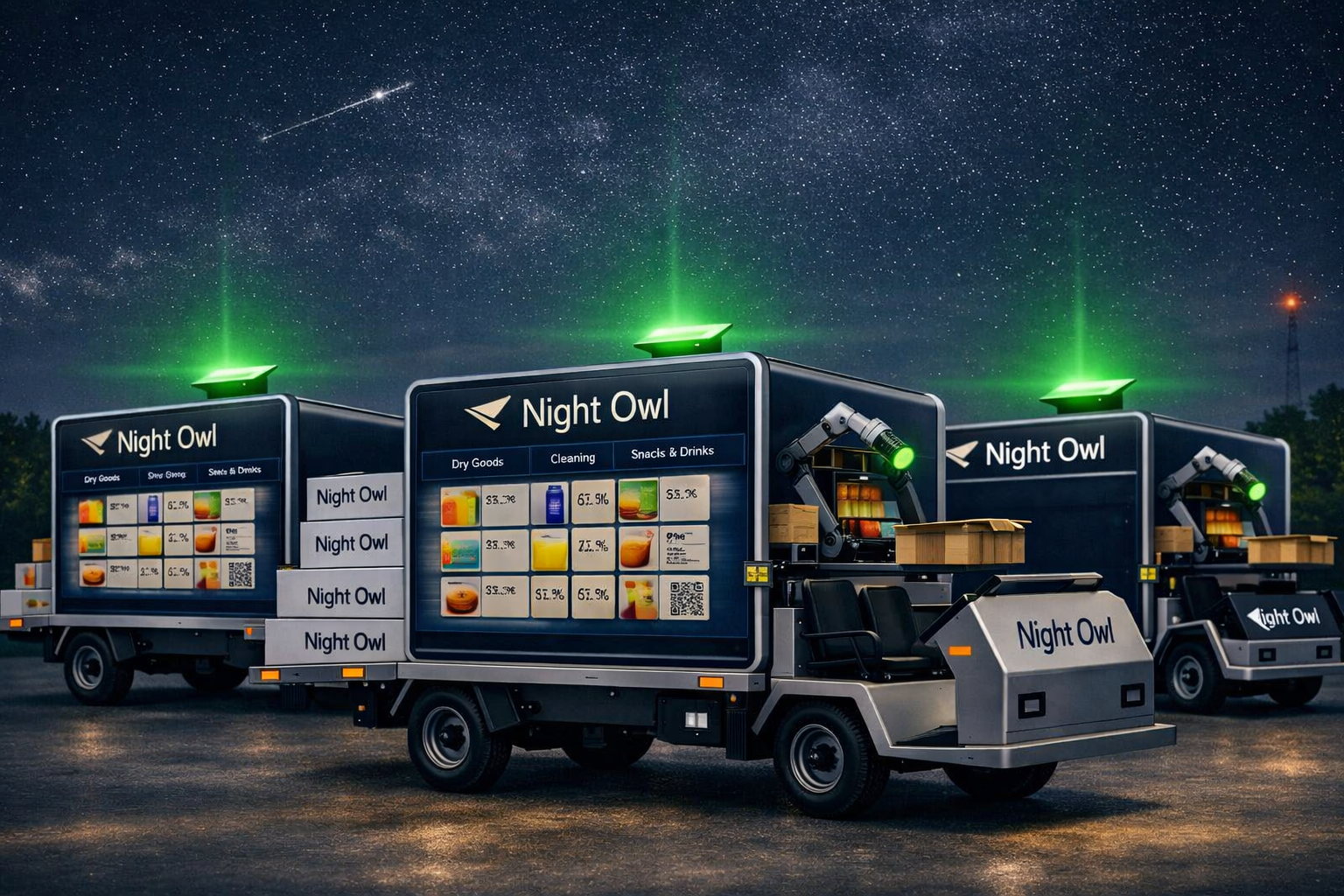
- A mobile, autonomous micro-store that sits inside neighborhoods — so when people run out, they can grab what they need in minutes.
- Walk-up or drive-up access. No delivery fees. No minimum order. No wait.
- Sells dry goods, essentials, paper goods, cleaning supplies, snacks, and everyday urgent-need items.
- Priced below general retail — wholesale economics passed directly to residents.
- Operates 24/7 with zero staff.
Need it now? It's right there. Cheaper than anywhere else nearby.
EVA Restock — Hyper-Local Wholesale Engine
Automates sourcing so essentials are always available.
- Connects to wholesale-only distributors across the Houston metro.
- Routes restock jobs based on price, distance, SLA, and availability.
- Integrates with suppliers via API, EDI, email, or manual intake.
- Ensures essentials are always available when people need them most.
- Generates a second revenue stream through logistics margin.
Smarter sourcing. Faster restock. Essentials always ready.
EVA DropShift — Last-Mile Gig Delivery Mesh
Restocks nodes quickly when suppliers don't integrate directly.
- Gig drivers pick up wholesale orders and deliver directly to EVA Mart nodes.
- Activates when distributor delivery is unavailable or too slow.
- Guarantees 2–8 hour restock cycles so urgent-need demand is never unmet.
- Generates a third revenue stream through delivery margin.
- Scales on demand using Houston's existing gig driver network.
Always stocked. Always on. No single supplier dependency.
EVA Cloud — Orchestration + Routing Layer
Keeps every node stocked and ready for urgent-need demand.
- Manages inventory, restock logic, and the supplier graph in real time.
- Routes DropShift jobs and enforces SLAs so nodes never go empty.
- Provides dashboards for property managers and EVA operators.
- Runs the autonomy logic for future EVA ADV vehicles.
- Foundation for scaling urgent-need coverage beyond the Houston metro.
One cloud. Every node. Always ready.
Space technology powers global-scale coordination.
EVA's distributed network relies on two critical space-enabled capabilities: real-time orbital insights for demand forecasting and continuous satellite communications for operational resilience.
Orbital Intelligence
Real-time Earth observation for demand signals.
- Satellite imagery feeds operational intelligence on foot traffic, dwell time, and demand patterns in real time.
- Enables predictive restock scheduling — know what neighborhoods need before urgent demand spikes.
- Validates node placement ROI by confirming neighborhood adoption and foot traffic patterns.
- Provides asset tracking and visibility across the entire EVA network fleet.
- Foundation for scaling to new cities with data-driven site selection.
See demand. Predict need. Optimize placement.
Starlink — Steady Communications Layer
Reliable connectivity for every node, everywhere.
- Satellite-backed internet ensures EVA nodes stay connected even during local network outages.
- Low-latency communication for real-time inventory updates and SLA compliance.
- Enables 24/7 autonomous operation without dependency on terrestrial cell coverage.
- Backup redundancy — if ground infrastructure fails, Starlink keeps logistics flowing.
- Foundation for expanding EVA network beyond Houston to underserved rural and remote neighborhoods.
Always connected. Never isolated. Network resilience built in.
EVA Mart — Urgent-need essentials, right where you are.
EVA Mart is a mobile, autonomous micro-store placed where people already are. When essentials run out, residents can restock in minutes without delivery fees or a supermarket trip.
Why residents reach for EVA Mart first
- Walk up or drive up with no lines or wasted time.
- Pre-order in the app and pick up in minutes.
- Priced below local general retail using wholesale economics.
- No delivery fees, tips, minimums, or surge pricing.
- Core urgent-need essentials stay in stock.
- Available at 2am at better local pricing.
Need it now? Walk up, grab it, go. No fees. No wait.
WAEV Taylor-Dunn Pilot — The bridge to full autonomy.
Before building its own Autonomous Delivery Vehicle, EVA validates every core assumption on a proven industrial platform. Phase 1 is about data, not hardware.
Target: 3+ purchases per active user per week. Track repeat rate, basket size, and time-of-day patterns in the first 30 days.
Target: identify the top 20 SKUs driving 80% of revenue within 30 days. Use results to optimize neighborhood catalogs.
Target: sub-4 hour average restock time. Confirm a 2-8 hour SLA across distributor and DropShift channels.
Target: qualify 5+ Houston distributors with confirmed pricing, SLA, and integration. Establish EVA Restock as the supplier routing layer.
Target: under 2-hour driver response with 90%+ job acceptance. Confirm per-delivery economics support positive margin at scale.
A staged path from traction to production-grade autonomy.
EVA advances through deliberate versions so each stage compounds validated data, autonomy capability, and deployment readiness.
Capital scales with capability by design.
EVA uses a stepwise cost ladder so each investment stage buys measurable operational capability and reduces downstream autonomy risk.
Three revenue streams today. Four tomorrow.
EVA earns on every transaction across the stack — from the shelf to the supplier to the driver. No single point of failure. No dependency on one margin.
Stream 1 — Retail Margin
Source: EVA Mart
- EVA buys at wholesale and sells at a margin below general retail.
- Residents get a better price. EVA keeps the spread.
- High-frequency, high-velocity purchases compound daily.
- Scales linearly with every unit deployed.
Every SKU sold is a margin event.
Stream 2 — Logistics Margin
Source: EVA Restock
- EVA routes restock jobs through its supplier network.
- Earns a margin on every wholesale order routed and fulfilled.
- Better routing equals lower cost equals higher margin over time.
- Supplier network deepens with every EVA Mart deployed.
The supply chain is a product, not a cost center.
Stream 3 — Delivery Margin
Source: EVA DropShift
- EVA pays gig drivers a fixed rate per delivery job.
- Charges a delivery margin on top for last-mile fulfillment.
- Activates on demand — zero salaried driver overhead.
- Covers fallback and primary delivery across underserved routes.
Gig economics. Infrastructure margins.
Stream 4 — Autonomy Margin
Source: EVA ADV (Future)
- As EVA ADV replaces gig drivers on high-density routes, delivery cost approaches zero.
- Full autonomy margin is captured on every delivery run.
- EVA Cloud handles routing, SLA enforcement, and vehicle dispatch.
- Phase 1 operational data is the foundation for ADV deployment.
The same network. Zero marginal delivery cost.
The moment for neighborhood retail is here.
The conditions that make EVA necessary and possible are converging now.
Real progress. Not just a deck.
EVA is not an idea. It is an operating company in build phase with real momentum.
- ✓ Enterprise software 95% complete
- ✓ Architecture locked
- → Supplier network forming
- → First EVA Mart unit in build phase
- → Houston deployment plan defined
What we're raising.
We are raising an angel round to deploy the first EVA Mart in Houston.
This round funds
- First EVA Mart unit build
- Houston deployment and site setup
- SKU selection and behavior validation
- Supplier network integration
- Early traction data and unit economics proof
One unit. Real data. The foundation for everything that follows.
Why angel, not seed VC
- This is validation capital — proving the unit model before scaling.
- Angels move faster and understand early-stage hardware deployment.
- The seed VC round comes after Phase 1 data is in hand.
- You are not betting on a deck — you are funding proof.
Angel capital now. Seed round to follow once the data is real.
Built by someone who lived the problem.
EVA Systems is a Houston-based startup building the infrastructure layer for autonomous neighborhood retail. Founded in 2025, EVA is designing the full stack — from the retail node to the supply engine to the delivery mesh — under one roof.
"I built EVA because I've lived the problem. When people run out of essentials, every option is slow, expensive, or inconvenient. I'm building EVA to fix that — starting in Houston."
- Architect of the EVA platform, business model, and go-to-market strategy.
- Designed the EVA Mart, Restock, DropShift, and Cloud stack from the ground up.
- Background in software and hardware systems design, supply chain automation, and autonomous retail.
- Leads product vision, investor relations, and platform roadmap.
Invest. Partner. Deploy.
EVA is raising a seed round and deploying its first urgent-need nodes in the Houston metro. Investors, property owners, distributors, and gig drivers each have a place in the EVA network.
Investors
Angel round open now.
- Request the full investor deck and financial model.
- Review Phase 1 pilot plan and unit economics.
- Meet the founder.
Property Owners & Operators
EVA nodes can be deployed on properties, campuses, and logistics hubs to serve urgent-need behavior where people live and work.
- Give tenants 24/7 access to essentials without adding staff or building a full store.
- No upfront cost, lease-heavy footprint, or staffing overhead.
- Earn passive revenue on every resident transaction.
- Increase satisfaction, dwell time, and retention with an on-site amenity people use.
Wholesale Distributors
Join the EVA Restock supplier network.
- Get routed restock jobs from EVA Mart nodes across the Houston metro.
- Integrate via API, EDI, email, or manual intake — your choice.
- Grow a predictable, recurring wholesale revenue channel.
Gig Drivers
Deliver for EVA DropShift.
- Pick up wholesale orders from local distributors and deliver to EVA Mart nodes.
- Fixed rate per job. No surge. No algorithm games.
- Flexible hours. Houston metro routes only.